
Article: A Field Guide to Premium Acetate Sunglasses
A Field Guide to Premium Acetate Sunglasses
What heritage should actually mean, what to look for in a frame, and an honest map of who is making them well.
Everyone says heritage now. It is on the sunglasses, the gin and the activewear. Most of the time it means a serif font and a sepia photograph. Occasionally it means something. We make acetate frames for a living. We would rather you bought a good pair than a loud one. Even if it is not ours.
Start with the material
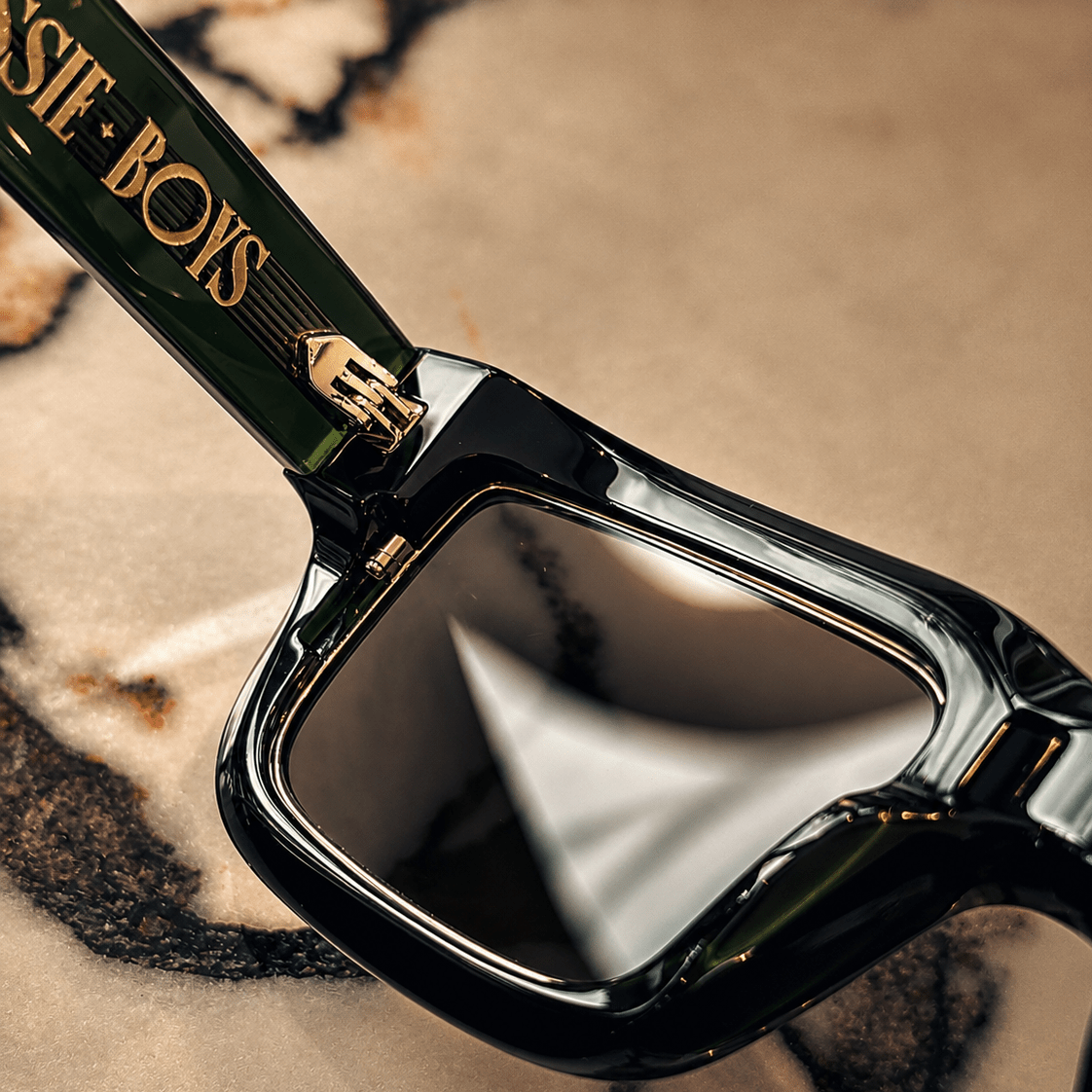
Most of the story lives in what a frame is made from. Cellulose acetate is a plant-based plastic, made from cotton and wood fibre. Good acetate is cut from solid block and finished by hand, which is why a proper frame has a depth and weight you can feel in the hand. Cheaper sunglasses tend to be injection-moulded nylon or polycarbonate, dressed up to look like the real thing. They photograph the same. They do not age the same.
If you want the longer version, we wrote about how cellulose acetate is made, and why it matters, over on the Journal.
What to look for
Four things separate a frame built to last from one built to sell.
Weight. A good acetate frame has heft. Not heavy, but present. If it feels like nothing in the hand, it is usually made of nothing much.
Hinges. Look for a metal core running through the temples and a proper barrel hinge. This is the part that fails first on a cheap frame, and the part you never see in a product photo.
Finishing. Hand-finished acetate carries faint variation, a slight unevenness in the polish or the depth of the colour. That is the mark of a human, not a fault. Factory frames are perfectly uniform because no one ever touched them.
Lenses. CR-39 and UV400 are the baseline worth holding out for. A Category 2 tint covers most daylight. Category 3 is for very bright glare. Polarised is a preference, not a requirement.
An honest map of the landscape
A few names worth knowing, at different ends of the room.
Jacques Marie Mage (United States). The reference point for narrative-led luxury eyewear. Numbered limited runs, heavy acetate, and prices that match the ambition. Aspirational, and priced like it.
Cubitts (United Kingdom). London-made and properly heritage, named after the streets it came from. A good benchmark for British eyewear done with restraint rather than noise.
Vehla and Oscar & Frank (Australia). Two of the better-known Australian acetate names. Vehla leans bright, sun-soaked and fashion-led. Oscar & Frank brings bolder, more playful shapes. Both sit closer to the trend end of the shelf than the heirloom end.
Jessie Boys (Australia). And then us. Jessie Boys sits in a gap we kept noticing and no one seemed to be filling. Premium acetate and British heritage, cut for men, at a price that does not require a second mortgage. One frame, the Finchley Cut, made properly, in runs of fewer than 150 pairs. We did not start with a range. We started with a standard. Inkwell Blue, Regency Green & Oxford Burgundy
The honest summary
If money is no object and you want a collector's piece, the luxury houses earn their price. If you want a frame with real weight, real heritage and a maker who answers their own email, there are a handful of us worth your time.
Buy the one you will still reach for in ten years. That is the whole test.

Written by gemma taylor

Leave a comment
This site is protected by hCaptcha and the hCaptcha Privacy Policy and Terms of Service apply.