
Article: What Is Cellulose Acetate — And Why Does It Matter?
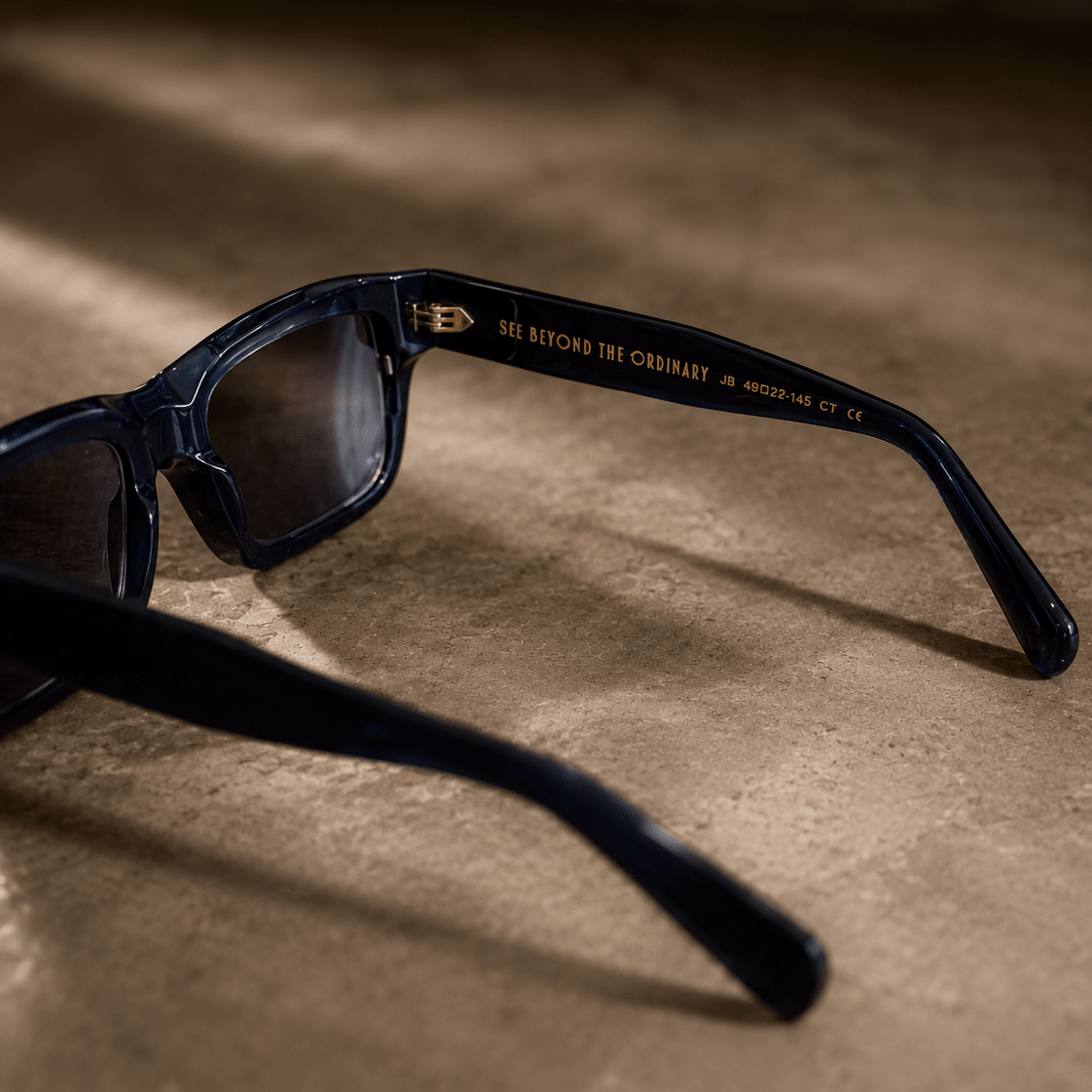
What Is Cellulose Acetate — And Why Does It Matter?
The material question every serious eyewear buyer should ask.
There's a moment when you pick up a pair of acetate frames and something registers before your brain catches up. A weight. A warmth. A sense that whatever you're holding was made by someone who gave a damn.
That feeling has a name: cellulose acetate.
It's the material behind the world's finest eyewear. Jacques Marie Mage uses it. Cutler & Gross uses it. Oliver Peoples built a reputation on it. And it's the material at the heart of every Jessie Boys frame.
Here's what it actually is, and why it matters more than most brands will tell you.
What Is Cellulose Acetate?
Cellulose acetate is a plant-derived material made primarily from wood pulp and cotton fibres. It's been used in eyewear manufacturing since the early twentieth century, when it replaced early celluloid plastics as the material of choice for quality optical frames.
It is not the same as the injection-moulded plastic used in mass-market sunglasses. The difference is significant.
Injection-moulded plastic frames are produced by melting polymer pellets and shooting them into a mould under pressure. Fast, cheap, consistent. The result is a lightweight frame with a slightly hollow feel. Functional, but lacking character.
Acetate frames begin as large blocks or sheets of material that are typically produced in Italy by specialist manufacturers, with Mazzucchelli being the most respected in the world. Those sheets are then cut, shaped, tumbled, and hand-finished over days or weeks. The process requires skilled hands at every stage.
The result is a frame with genuine depth: in colour, in weight, in the way it wears.
Why Acetate Ages Better
One of acetate's least-discussed qualities is how it behaves over time. Unlike synthetic plastics, which tend to fade and become brittle, quality acetate develops what collectors call a patina which is a subtle evolution in the material's surface and depth of colour that comes from wear and exposure.
A pair of acetate frames worn daily for five years looks lived-in in the best possible way. They carry something.
This is partly why acetate frames hold their value and why they tend to be the material of choice for collectors and those who approach eyewear as a long-term investment rather than a seasonal accessory.
The Hand-Finishing Difference
Acetate frames cannot be fully automated. After the initial cutting and shaping, each frame goes through a tumbling process that typically takes 3 to 5 days in a rotating drum with abrasive materials that smooths edges and develops the surface lustre. After tumbling, skilled technicians hand-polish each frame, fit the temples, align the hinges, and check for consistency.
At Jessie Boys, we produce in runs of fewer than 150 pairs. That number isn't a marketing decision rather it's a reflection of what's possible when you're making things properly. Each frame carries the subtle variations that are the mark of human craftsmanship rather than factory uniformity.
We consider those nuances a feature.
What to Look for in Acetate Sunglasses
If you're assessing an acetate frame either ours or anyone else's, here's what to check:
Weight. Quality acetate has genuine heft. Not heavy, but present. If a frame feels insubstantial in the hand, it almost certainly isn't acetate.
Colour depth. Acetate colour runs all the way through the material. Hold the frame up to light — you should see the colour shift and develop. Painted plastic looks flat. Acetate looks alive.
Edge quality. Run your finger along the inside edge of the temples. Quality acetate feels smooth and warm. Rough edges or a cold, hollow feel suggests injection-moulding.
Hinge construction. Barrel hinges set into the frame indicate quality. Five-barrel hinges are a further sign of care. Spring hinges embedded in acetate can be a weak point on lesser frames.
Temple cores. The finest acetate frames include a metal core running the length of each temple. This gives structural integrity and allows the temples to be gently adjusted for fit. The Finchley Cut uses reinforced dual metal core temples for exactly this reason.
Why We Chose Acetate
When we were developing the Finchley Cut, we didn't start with a material and work backwards. We started with the feeling we wanted someone to have when they picked up the frame.
Grounded. Thought out. The kind of thing you don't replace.
Acetate was the only answer. Everything else was a compromise.
For the The Second Cut production run, we're working with one of the world's most respected eyewear manufacturing regions, using premium Italian acetate. Two of the best names in the business.
That's the standard. That's why it matters.
The Finchley Cut Founders Edition is available now in Inkwell Blue, Regency Green, and Oxford Burgundy. Fewer than 150 pairs across all colourways.

Written by gemma taylor


Leave a comment
This site is protected by hCaptcha and the hCaptcha Privacy Policy and Terms of Service apply.