
The Finchley Cut — Why We Designed It This Way
The Real Brief
Brent has sensitive eyes. Genuinely, not in the way people say it casually, but in the way that makes long days outdoors genuinely difficult without the right pair of glasses. Finding frames that worked for him had always been harder than it should be. He also has a larger head, which sounds like a minor detail until you've spent years picking up frames that look right on the shelf and feel wrong on your face. Proportion matters. Most brands design for the average and hope for the best.
There was something else, too. A pair of glasses that fit properly and feel solid and present on your face do something quietly useful in social situations. They give you somewhere to be. A layer between you and the room that isn't obvious to anyone else but matters to the person wearing them. Armour is too dramatic a word. But not entirely wrong.
So the brief, if we're being honest, was personal. Eyes that need protecting. A face that needs frames built for actual presence. And a desire to wear something that felt genuinely distinctive rather than generically premium.
We couldn't find it. So we made it.
The Name
Finchley is a suburb in North London. We liked the name. That's the truth of it.
It has a feeling. Residential, understated, a place that doesn't announce itself. And The Cut felt right for the silhouette. Sharp. Decided. A frame that looks like someone made a choice.
The Finchley Cut. It stuck immediately and we never looked for another name.
The Silhouette
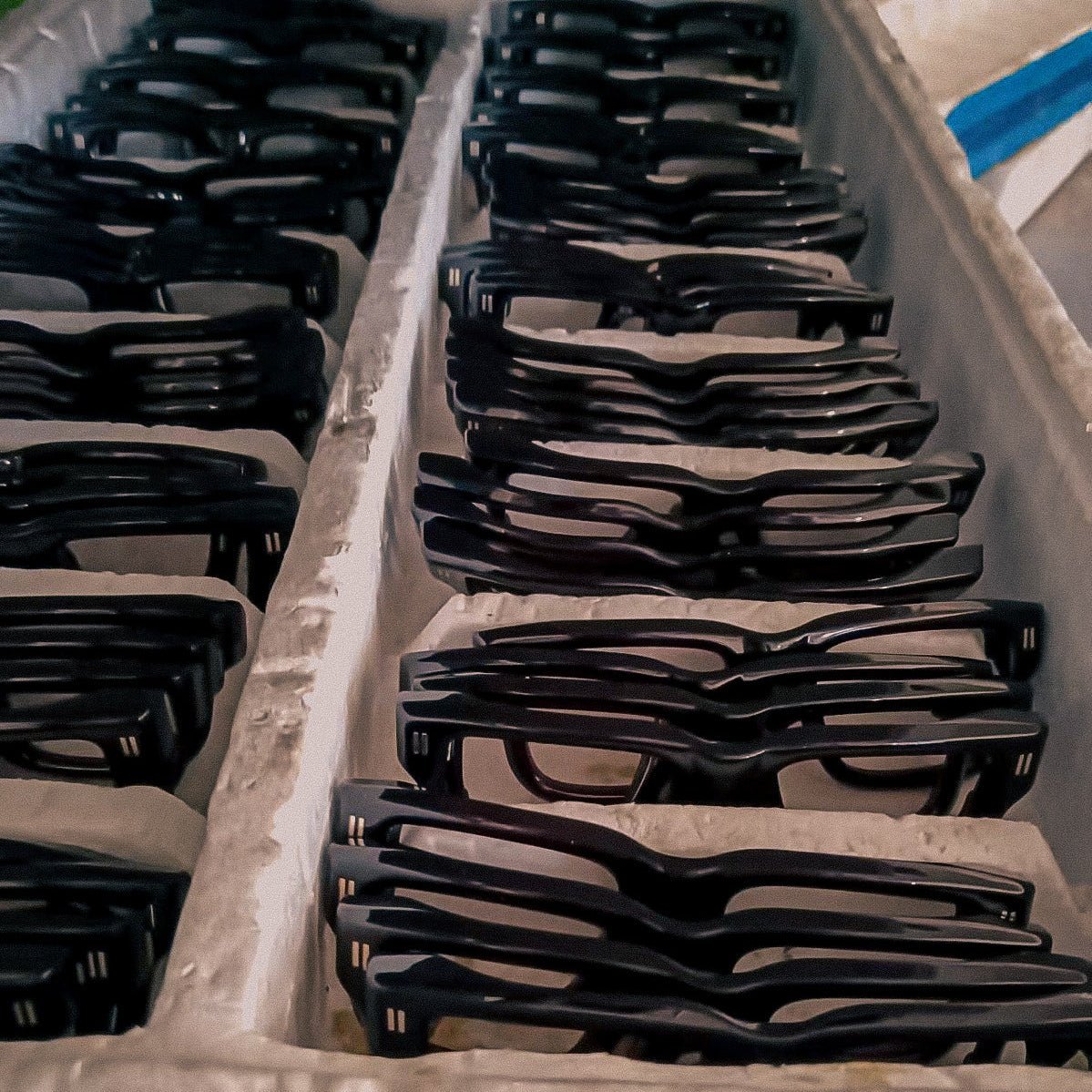
The Finchley Cut is a structured rectangular frame. We chose this shape because it's the one that disappears from trends entirely. Rectangular acetate frames have a heritage that runs through the best decades of British and European eyewear, worn by architects and writers and men who dressed with care but not performance. They don't date. In ten years the Finchley Cut will look like a well-chosen classic, not a relic of a particular moment.
We gave it a wider lens than is currently fashionable. Deliberate. Oversized comes and goes. Narrow comes and goes. A medium-wide rectangular frame with genuine presence sits outside that conversation entirely.
The temples are thick. Most acetate frames lose their nerve here and taper too aggressively, chasing a lighter feel at the cost of presence. We kept the weight. The frame should feel like something when you pick it up.
The Colourways
We launched with three. Not ten. Three.
The decision not to include black was deliberate. Black is the default, the safe answer, the one that requires no commitment. We wanted the colourways to set a mood, to ask something of the person wearing them. Not loudly. But unmistakably.
Inkwell Blue is deep navy. Grounded and quiet. The colour of ink and depth.
Regency Green is richer, a forest tone that references English country without cosplaying it. The colourway that surprises people most once they try it on.
Oxford Burgundy is the one people think they won't wear until they put it on. Deep, plum-adjacent, rooted in heritage. The frame that converts people who thought colour wasn't for them.
All three run through the full depth of the acetate. Hold them up to light and the colour shifts and develops. That's the material doing what only acetate can do.
The Details
Three details define the Finchley Cut.
The inner metal rim is a fine metal detail running the interior edge of the frame front. It catches light differently to the acetate around it and gives the frame a secondary dimension when someone looks at you. A quiet flourish hidden in plain sight. The kind of detail that rewards close attention without demanding it.
The keyhole bridge is subtle and slightly architectural, referencing the bridge designs used in vintage optical frames. Functional in shape and characterful in detail, it sits comfortably across different nose profiles without sliding or pinching. That matters when you're designing for a real face rather than an idealised one.
The gold Jessie Boys typography on the temples is not a logo mark. It's the name itself, set in gold. The kind of detail you notice on close inspection and appreciate for what it doesn't do. It doesn't compete with the frame. It completes it.
Each frame uses reinforced dual metal core temples, which allow gentle adjustment for fit and give the frame a rigidity that pure acetate can't match. The temple length was something we adjusted many times to get right. Longer than most, which is what makes them work across a wider range of heads than you'd expect. Brent has a larger head and they fit properly. Gem has a smaller head and they sit just slightly generous on her. In practice we haven't found a head they don't work on, which after all that iteration feels like exactly the right outcome.
The Run
Fewer than 150 pairs across all three colourways. This is the Founders Edition.
We didn't limit the run as a device. We limited it because making things properly at this stage means making them in the right numbers. The Second Cut is coming, refined and developed, the same philosophy taken further. But for now, 150 pairs.
The people who find them early will understand why.
What We Were Actually Designing
A frame for the man who has stopped proving himself.
Who knows the difference between a well-made thing and an expensive thing. Who wants to walk into a room and feel settled rather than seen. Who picks something up, feels it, and knows without needing anyone to tell him why.
That was always the frame we were trying to make. The Finchley Cut is just what it looks like when we got there.
The Finchley Cut Founders Edition is available now in Inkwell Blue, Regency Green, and Oxford Burgundy. Fewer than 150 pairs across all colourways.

Written by gemma taylor

Leave a comment
This site is protected by hCaptcha and the hCaptcha Privacy Policy and Terms of Service apply.